Package winappdbg :: Module system :: Class ThreadDebugOperations
[hide private]
[frames] | no frames]

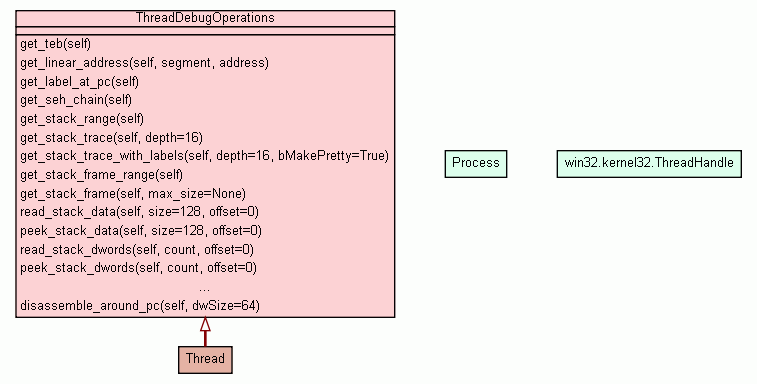
Class ThreadDebugOperations


Encapsulates several useful debugging routines for threads.

Instance Methods [hide private]
tuple of tuple( int, int, str )
__get_stack_trace(self, depth=16, bUseLabels=True, bMakePretty=True)
Tries to get a stack trace for the current function.

Inherited from object: __delattr__, __format__, __getattribute__, __hash__, __init__, __new__, __reduce__, __reduce_ex__, __repr__, __setattr__, __sizeof__, __str__, __subclasshook__

    Properties
TEB
get_teb(self)
Returns a copy of the TEB.
    Disassembly
list of tuple( long, int, str, str )
disassemble(self, lpAddress, dwSize)
Disassemble instructions from the address space of the process.
list of tuple( long, int, str, str )
disassemble_around(self, lpAddress, dwSize=64)
Disassemble around the given address.
list of tuple( long, int, str, str )
disassemble_around_pc(self, dwSize=64)
Disassemble around the program counter of the given thread.
    Stack
tuple( int, int )
get_stack_range(self)
Returns: Stack beginning and end pointers, in memory addresses order.
tuple of tuple( int, int, str )
get_stack_trace(self, depth=16)
Tries to get a stack trace for the current function.
tuple of tuple( int, int, str )
get_stack_trace_with_labels(self, depth=16, bMakePretty=True)
Tries to get a stack trace for the current function.
tuple( int, int )
get_stack_frame_range(self)
Returns the starting and ending addresses of the stack frame.
str
get_stack_frame(self, max_size=None)
Reads the contents of the current stack frame.
str
read_stack_data(self, size=128, offset=0)
Reads the contents of the top of the stack.
str
peek_stack_data(self, size=128, offset=0)
Tries to read the contents of the top of the stack.
tuple( int... )
read_stack_dwords(self, count, offset=0)
Reads DWORDs from the top of the stack.
tuple( int... )
peek_stack_dwords(self, count, offset=0)
Tries to read DWORDs from the top of the stack.
    Miscellaneous
int
get_linear_address(self, segment, address)
Translates segment-relative addresses to linear addresses.
str
get_label_at_pc(self)
Returns: Label that points to the instruction currently being executed.
list of tuple( int, int )
get_seh_chain(self)
Returns: List of structured exception handlers.
str
read_code_bytes(self, size=128, offset=0)
Tries to read some bytes of the code currently being executed.
str
peek_code_bytes(self, size=128, offset=0)
Tries to read some bytes of the code currently being executed.
dict( str → str )
peek_pointers_in_registers(self, peekSize=16, context=None)
Tries to guess which values in the registers are valid pointers, and reads some data from them.
dict( str → str )
peek_pointers_in_data(self, data, peekSize=16, peekStep=1)
Tries to guess which values in the given data are valid pointers, and reads some data from them.
Static Methods [hide private]
    Disassembly
list of tuple( long, int, str, str )
disassemble_string(lpAddress, code)
Disassemble instructions from a block of binary code.
Properties [hide private]

Inherited from object: __class__

Method Details [hide private]

get_teb(self)


Returns a copy of the TEB. To dereference pointers in it call Process.read_structure.

Returns: TEB
TEB structure.

get_linear_address(self, segment, address)


Translates segment-relative addresses to linear addresses.

Linear addresses can be used to access a process memory, calling Process.read and Process.write.

Parameters:
  • segment (str) - Segment register name.
  • address (int) - Segment relative memory address.
Returns: int
Linear memory address.

get_label_at_pc(self)

 
Returns: str
Label that points to the instruction currently being executed.

get_seh_chain(self)

 
Returns: list of tuple( int, int )
List of structured exception handlers. Each SEH is represented as a tuple of two addresses:
  • Address of the SEH block
  • Address of the SEH callback function

get_stack_range(self)

 
Returns: tuple( int, int )
Stack beginning and end pointers, in memory addresses order.

__get_stack_trace(self, depth=16, bUseLabels=True, bMakePretty=True)


Tries to get a stack trace for the current function. Only works for functions with standard prologue and epilogue.

Parameters:
  • depth (int) - Maximum depth of stack trace.
  • bUseLabels (bool) - True to use labels, False to use addresses.
Returns: tuple of tuple( int, int, str )
Stack trace of the thread as a tuple of ( return address, frame pointer address, module filename ) when bUseLabels is True, or a tuple of ( return address, frame pointer label ) when bUseLabels is False.

get_stack_trace(self, depth=16)


Tries to get a stack trace for the current function. Only works for functions with standard prologue and epilogue.

Parameters:
  • depth (int) - Maximum depth of stack trace.
Returns: tuple of tuple( int, int, str )
Stack trace of the thread as a tuple of ( return address, frame pointer address, module filename ).

get_stack_trace_with_labels(self, depth=16, bMakePretty=True)


Tries to get a stack trace for the current function. Only works for functions with standard prologue and epilogue.

Parameters:
  • depth (int) - Maximum depth of stack trace.
  • bMakePretty (bool) - True for user readable labels, False for labels that can be passed to Process.resolve_label.

    "Pretty" labels look better when producing output for the user to read, while pure labels are more useful programatically.

Returns: tuple of tuple( int, int, str )
Stack trace of the thread as a tuple of ( return address, frame pointer label ).

get_stack_frame_range(self)


Returns the starting and ending addresses of the stack frame. Only works for functions with standard prologue and epilogue.

Returns: tuple( int, int )
Stack frame range. May not be accurate, depending on the compiler used.
Raises:
  • RuntimeError - The stack frame is invalid, or the function doesn't have a standard prologue and epilogue.
  • WindowsError - An error occured when getting the thread context.

get_stack_frame(self, max_size=None)


Reads the contents of the current stack frame. Only works for functions with standard prologue and epilogue.

Parameters:
  • max_size (int) - (Optional) Maximum amount of bytes to read.
Returns: str
Stack frame data. May not be accurate, depending on the compiler used. May return an empty string.
Raises:
  • RuntimeError - The stack frame is invalid, or the function doesn't have a standard prologue and epilogue.
  • WindowsError - An error occured when getting the thread context or reading data from the process memory.

read_stack_data(self, size=128, offset=0)


Reads the contents of the top of the stack.

Parameters:
  • size (int) - Number of bytes to read.
  • offset (int) - Offset from the stack pointer to begin reading.
Returns: str
Stack data.
Raises:
  • WindowsError - Could not read the requested data.

peek_stack_data(self, size=128, offset=0)


Tries to read the contents of the top of the stack.

Parameters:
  • size (int) - Number of bytes to read.
  • offset (int) - Offset from the stack pointer to begin reading.
Returns: str
Stack data. Returned data may be less than the requested size.

read_stack_dwords(self, count, offset=0)


Reads DWORDs from the top of the stack.

Parameters:
  • count (int) - Number of DWORDs to read.
  • offset (int) - Offset from the stack pointer to begin reading.
Returns: tuple( int... )
Tuple of integers read from the stack.
Raises:
  • WindowsError - Could not read the requested data.

peek_stack_dwords(self, count, offset=0)


Tries to read DWORDs from the top of the stack.

Parameters:
  • count (int) - Number of DWORDs to read.
  • offset (int) - Offset from the stack pointer to begin reading.
Returns: tuple( int... )
Tuple of integers read from the stack. May be less than the requested number of DWORDs.

read_code_bytes(self, size=128, offset=0)


Tries to read some bytes of the code currently being executed.

Parameters:
  • size (int) - Number of bytes to read.
  • offset (int) - Offset from the program counter to begin reading.
Returns: str
Bytes read from the process memory.
Raises:
  • WindowsError - Could not read the requested data.

peek_code_bytes(self, size=128, offset=0)


Tries to read some bytes of the code currently being executed.

Parameters:
  • size (int) - Number of bytes to read.
  • offset (int) - Offset from the program counter to begin reading.
Returns: str
Bytes read from the process memory. May be less than the requested number of bytes.

peek_pointers_in_registers(self, peekSize=16, context=None)


Tries to guess which values in the registers are valid pointers, and reads some data from them.

Parameters:
  • peekSize (int) - Number of bytes to read from each pointer found.
  • context (dict( str → int )) - (Optional) Dictionary mapping register names to their values. If not given, the current thread context will be used.
Returns: dict( str → str )
Dictionary mapping register names to the data they point to.

peek_pointers_in_data(self, data, peekSize=16, peekStep=1)


Tries to guess which values in the given data are valid pointers, and reads some data from them.

Parameters:
  • data (str) - Binary data to find pointers in.
  • peekSize (int) - Number of bytes to read from each pointer found.
  • peekStep (int) - Expected data alignment. Tipically you specify 1 when data alignment is unknown, or 4 when you expect data to be DWORD aligned. Any other value may be specified.
Returns: dict( str → str )
Dictionary mapping stack offsets to the data they point to.

disassemble_string(lpAddress, code)
Static Method


Disassemble instructions from a block of binary code.

Parameters:
  • lpAddress (int) - Memory address where the code was read from.
  • code (str) - Binary code to disassemble.
Returns: list of tuple( long, int, str, str )
List of tuples. Each tuple represents an assembly instruction and contains:
  • Memory address of instruction.
  • Size of instruction in bytes.
  • Disassembly line of instruction.
  • Hexadecimal dump of instruction.

disassemble(self, lpAddress, dwSize)


Disassemble instructions from the address space of the process.

Parameters:
  • lpAddress (int) - Memory address where to read the code from.
  • dwSize (int) - Size of binary code to disassemble.
Returns: list of tuple( long, int, str, str )
List of tuples. Each tuple represents an assembly instruction and contains:
  • Memory address of instruction.
  • Size of instruction in bytes.
  • Disassembly line of instruction.
  • Hexadecimal dump of instruction.

disassemble_around(self, lpAddress, dwSize=64)


Disassemble around the given address.

Parameters:
  • lpAddress (int) - Memory address where to read the code from.
  • dwSize (int) - Delta offset. Code will be read from lpAddress - dwSize to lpAddress + dwSize.
Returns: list of tuple( long, int, str, str )
List of tuples. Each tuple represents an assembly instruction and contains:
  • Memory address of instruction.
  • Size of instruction in bytes.
  • Disassembly line of instruction.
  • Hexadecimal dump of instruction.

disassemble_around_pc(self, dwSize=64)


Disassemble around the program counter of the given thread.

Parameters:
  • dwSize (int) - Delta offset. Code will be read from pc - dwSize to pc + dwSize.
Returns: list of tuple( long, int, str, str )
List of tuples. Each tuple represents an assembly instruction and contains:
  • Memory address of instruction.
  • Size of instruction in bytes.
  • Disassembly line of instruction.
  • Hexadecimal dump of instruction.